
Test New Employee Knowledge During Onboarding
If you are wondering how to test new employee knowledge during onboarding, the fact that you are asking means you have already noticed the problem: new hires finish their training modules, check every box, and still show up to their first real assignment unsure of basic processes, compliance protocols, or even who to escalate issues to. The completion rate on your onboarding dashboard says 100 percent. The reality on the floor says otherwise. The gap between completing training and actually retaining knowledge is the most expensive blind spot in modern onboarding, and most companies never measure it because they confuse attendance with understanding.
Why Completion Tracking Is Not Knowledge Testing
The typical onboarding technology stack tracks whether a new hire opened a document, watched a video, or clicked through a slide deck. None of that tells you whether they understood it. A 2023 study by Brandon Hall Group found that 44 percent of organizations rate their onboarding programs as ineffective at preparing employees for their roles, yet most of those same organizations rely solely on self-reported surveys and manager check-ins to gauge readiness. Surveys measure sentiment. Check-ins measure confidence. Neither measures actual knowledge retention.
Structured knowledge assessments are different. They ask a new hire to demonstrate comprehension at specific milestones, using question types calibrated to the depth of understanding required at that stage. When designed correctly, they do not just grade the employee. They grade your onboarding content. If 70 percent of a new hire cohort fails the same question about your data handling policy, the problem is not 70 percent of your hires. The problem is your data handling training module.
A Phased Framework for Onboarding Knowledge Assessments
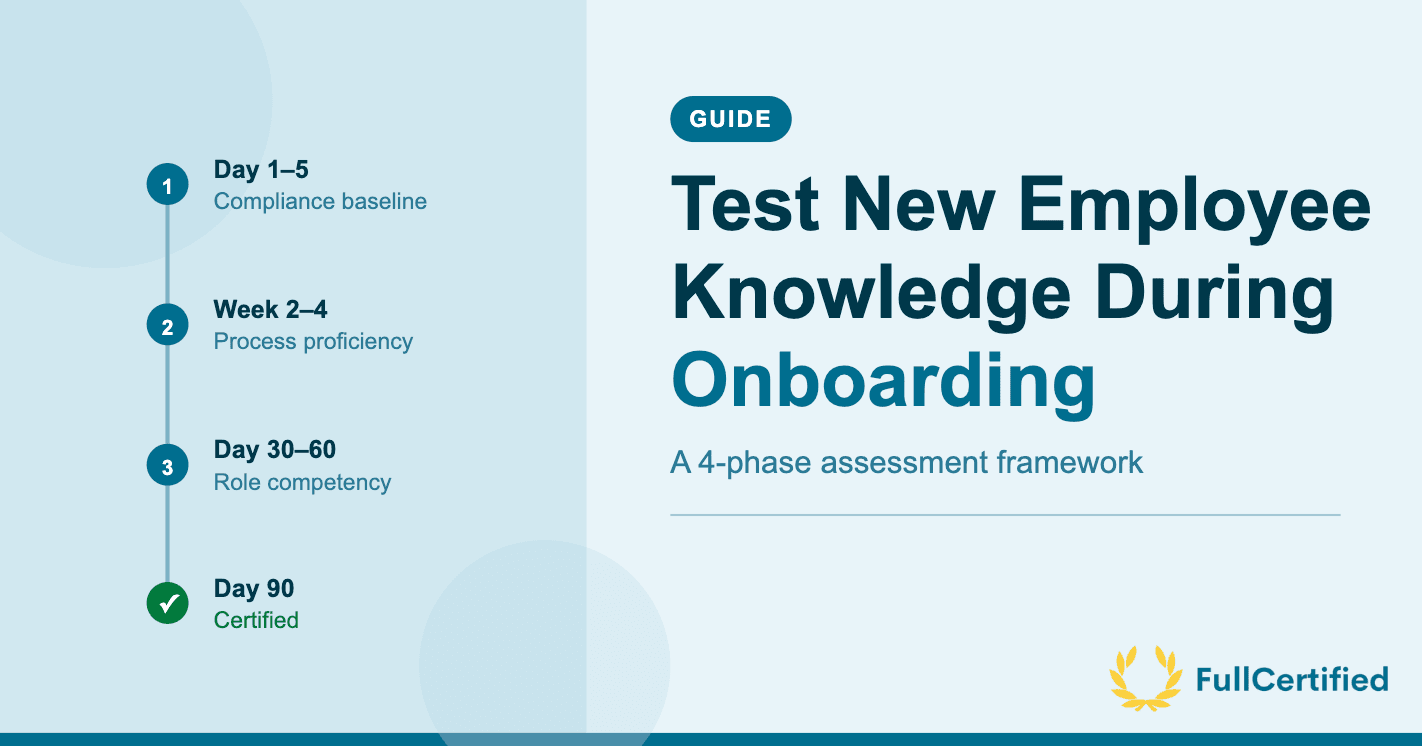
Effective onboarding testing is not a single quiz at the end of a training week. It is a system of escalating assessments tied to specific milestones. Below is a four-phase framework that maps assessment types to the knowledge depth required at each stage of the onboarding journey.
Phase 1: Day 1 to Day 5 — Compliance and Culture Baseline
The first week focuses on foundational knowledge that every employee must retain regardless of role: workplace safety, harassment policies, IT security protocols, company values, and organizational structure. Assessments at this stage should be low-stakes but non-negotiable. Use multiple-choice and true-or-false questions that verify factual recall. Set a passing threshold of 90 percent because compliance knowledge is binary, employees either know the correct escalation path for a safety incident or they do not.
Question types: Multiple-choice, true-or-false, matching (for example, match each compliance scenario to the correct reporting channel)
Timing: Deploy the assessment immediately after each training module, not at the end of the week
Passing threshold: 90 percent with unlimited retakes, but track how many attempts each hire needs
What to measure: First-attempt pass rate across the cohort to identify weak training modules
Phase 2: Week 2 to Week 4 — Process and Systems Proficiency
Once foundational knowledge is confirmed, assessments should shift to operational competency. Can the new hire navigate your CRM correctly? Do they understand the ticketing workflow? Can they identify which internal tool to use for a given task? This phase requires scenario-based questions that test application, not just recall. Present a realistic situation and ask the hire to select the correct sequence of actions or identify the right tool for the job.
Question types: Scenario-based multiple-choice, sequencing questions (put these steps in order), short-answer for tool-specific tasks
Timing: End of week two for general systems, end of week four for role-specific workflows
Passing threshold: 80 percent, with targeted retraining on missed sections rather than full module repetition
What to measure: Question-level analytics showing which processes are consistently misunderstood
Phase 3: Day 30 to Day 60 — Role-Specific Competency Assessment
By day 30, new hires should demonstrate that they can apply knowledge independently. Assessments here should simulate real job tasks. For a customer support representative, this might mean reviewing a mock customer complaint and writing the appropriate response. For a project manager, it might involve reading a project brief and identifying the three highest-priority risks. These assessments require open-ended or short-answer questions graded against a rubric, or carefully designed multiple-choice questions that require multi-step reasoning.
Question types: Case study scenarios, short-answer with rubric scoring, multi-select questions with partial credit
Timing: Day 30 checkpoint and Day 60 checkpoint
Passing threshold: 75 percent at Day 30 with a structured improvement plan for those below, 85 percent at Day 60
What to measure: Score improvement between the two checkpoints to assess learning velocity
Phase 4: Day 90 — Certification and Readiness Confirmation
The 90-day assessment should function as a formal certification that the employee has completed onboarding and is fully operational. This is the assessment you can share with the employee's manager, attach to their HR file, and reference in performance reviews. It should cover a cross-section of compliance, process, and role-specific knowledge. Employees who pass should receive a professional certificate. Those who do not should enter a documented remediation path, not simply be told to review the materials again.
Question types: Comprehensive mixed-format exam combining all previous question types
Timing: Day 90, with results reviewed in a three-way meeting between the hire, their manager, and HR
Passing threshold: 85 percent overall with minimum section scores of 80 percent in each domain
What to measure: Cohort-wide pass rates compared to previous cohorts, average scores by section, time to completion
Turning Assessment Data into Onboarding Content Improvements
This is where most onboarding assessment strategies stop, and it is exactly where yours should accelerate. Individual scores tell you who needs help. Aggregate scores tell you what needs to be fixed. When you analyze assessment results at the question level across an entire cohort, patterns emerge that are invisible at the individual level.
Here is a practical example. A mid-size SaaS company onboards 15 new customer success managers per quarter. After implementing phased assessments, their L&D team noticed that 68 percent of new hires in three consecutive cohorts scored below 60 percent on questions related to the escalation process for at-risk accounts. The hires were not failing. The training video covering that process was six months outdated and referenced a workflow the team had since replaced. Without question-level analytics across cohorts, that content gap would have continued producing unprepared employees indefinitely.
To replicate this, build a simple feedback loop into your assessment process.
After each cohort completes a phased assessment, export question-level results showing the percentage of correct responses per question.
Flag any question where fewer than 70 percent of the cohort answered correctly on the first attempt.
Review the corresponding training content for those flagged questions. Determine whether the content is unclear, outdated, or insufficient.
Update the training content and monitor whether the next cohort's scores on those same questions improve.
If scores do not improve after a content revision, the issue may be instructional design, such as delivery format or sequencing, rather than content accuracy.
Choosing the Right Question Types for Each Knowledge Level
Not every question type works for every assessment phase. Matching question types to the cognitive level you are testing prevents you from over-testing recall when you need to test application, or asking open-ended analysis questions when simple factual verification is the goal.
Recall and recognition: True-or-false, multiple-choice, matching. Best for compliance and policy knowledge in Phase 1.
Comprehension and application: Scenario-based multiple-choice, sequencing, fill-in-the-blank. Best for process knowledge in Phase 2.
Analysis and evaluation: Case studies, multi-step scenarios, short-answer with rubric. Best for role-specific competency in Phases 3 and 4.
A common mistake is relying exclusively on multiple-choice for all phases. Multiple-choice questions are easy to auto-grade and scale, but they cap out at testing recognition. By Phase 3, you need to know whether an employee can construct an answer, not just recognize one.
Automating the Entire Framework with FullCertified
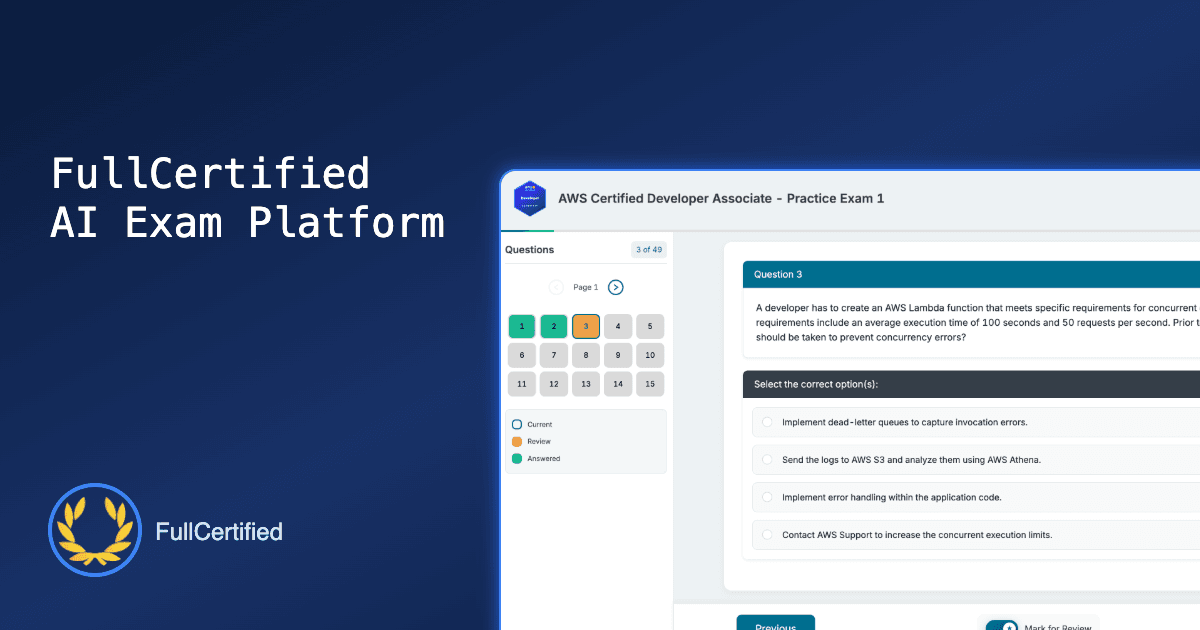
Building a phased assessment framework on paper is one thing. Running it consistently across every new hire cohort without drowning your HR team in manual work is another. This is where a purpose-built assessment platform becomes essential. FullCertified is designed specifically for organizations that need to create, deploy, and analyze structured knowledge assessments at scale, and it maps directly to every phase of the framework described above.
AI quiz builder: Generate assessment questions from your existing onboarding documents, SOPs, and training decks in minutes instead of hours. The AI suggests question types based on content complexity, aligning with the recall-to-analysis progression across phases.
Auto-grading with passing thresholds: Set custom passing scores for each assessment phase. Employees who fall below the threshold are automatically flagged, and results are routed to the appropriate manager or L&D lead.
Detailed analytics and cohort tracking: View question-level performance data across entire cohorts, not just individual hires. Identify the exact questions and training content that are consistently producing low scores.
Group management: Organize new hires by cohort, department, or location. Deploy the right assessments to the right groups at the right milestones without manual scheduling.
Professional certificates: When a new hire passes their 90-day certification exam, FullCertified automatically generates a branded, verifiable certificate that can be stored in their employee file or shared with their manager.
Mobile app access: New hires can complete assessments from any device, which is critical for distributed teams and remote onboarding programs.
Custom branding and SSO: Assessments look and feel like part of your existing onboarding environment, not a third-party tool. Single sign-on integration means one less login for new hires to manage during an already overwhelming first week.
Study materials export: Before each assessment, new hires can access exported study guides pulled directly from the training content the assessment covers, closing the gap between learning and testing.
The combination of AI-powered question generation, automated grading, and cohort-level analytics means your L&D team spends their time analyzing results and improving onboarding content, not manually creating quizzes and chasing completion data in spreadsheets.
Setting Up Your Scoring Rubric and Remediation Paths
A knowledge assessment without a clear response plan for low scores is just a test for the sake of testing. Every assessment phase should have a predefined remediation path that is proportional to the stakes of that phase.
Phase 1 (compliance): Immediate retake with the same question bank. If a hire fails twice, schedule a one-on-one walkthrough of the missed topics before they proceed.
Phase 2 (process): Assign targeted micro-learning on the specific processes missed. Reassess only on those topics within five business days.
Phase 3 (role competency): Pair the hire with a peer mentor for the specific skill area. Schedule a reassessment at Day 45 or Day 75 depending on the checkpoint.
Phase 4 (certification): If the hire does not pass the 90-day certification, create a documented 30-day improvement plan with the manager. Reassess at Day 120. If the hire fails again, escalate to an HR review of role fit.
Document these paths in advance so that managers and new hires both understand that assessments are developmental tools, not gotcha moments. Transparency about what happens when scores are low significantly reduces test anxiety and increases honest engagement with the assessment process.
Common Mistakes That Undermine Onboarding Assessments
Even well-intentioned onboarding assessment programs fail when they fall into predictable traps. Avoid these to keep your framework effective and trusted.
Testing too late: A single assessment at the end of onboarding week tells you nothing about where knowledge broke down. Test at each phase so you can intervene early.
Testing only recall: If every question can be answered by memorizing a document, you are not measuring readiness. Incorporate scenario-based and application questions starting in Phase 2.
Ignoring aggregate data: Individual scores matter for the employee. Aggregate scores matter for your program. If you are not analyzing cohort-level results, you are missing the most valuable insight assessments can provide.
No feedback loop to content creators: Assessment results should directly inform updates to training content. If your L&D team never sees assessment analytics, the data is wasted.
Making it punitive: If new hires perceive assessments as threats rather than support tools, they will game the system rather than engage honestly. Frame every assessment as a way to help them succeed, not to catch them failing.
Start Building Your Onboarding Assessment System Today
The difference between companies that onboard effectively and companies that simply orient is a structured knowledge verification system. You already have the onboarding content. You already have the new hires. What you need is the layer between them that confirms understanding actually happened, identifies where it did not, and tells you whether the problem is the learner or the lesson.
FullCertified gives you every tool to build, automate, and continuously improve that layer, from AI-generated assessments and auto-grading to cohort analytics and professional certification. Stop measuring onboarding by completion rates. Start measuring it by what your people actually know. Visit FullCertified to create your first onboarding assessment in minutes.